top of page

Understanding scar coverups and camouflage tattoos

  • Writer: Albatross
    Albatross
  • Nov 23, 2025
  • 3 min read

Updated: Nov 25, 2025

What You Need to Know if you're considering taking this leap of faith


I wish it was as easy as walking into a studio getting a tattoo that will make a scar disappear. Bad news is... its not that easy, Good news is... you have options!


Sometimes, tattooing over scar tissue can be powerful and healing – turning something you hate into something you chose. Other times, it’s the wrong tool for the job and can actually make the area look worse.

If you’re thinking about getting a tattoo to cover or camouflage a scar, here’s the honest version of what’s possible, what’s risky, and how I approach it in the studio.


tattooing over scars and understanding the process

Not All Scars Are created equal! How well a tattoo will work depends on what kind of scar you have. Here's a list of common scar types:

Flat, pale scars, Raised (hypertrophic) scars, Keloid scars, Burn scars and most commonly, stretch marks.


Timing

Ideally, wait at least 12 months after the injury or surgery for minor scars. In some cases (especially big surgical or burn scars), 18–24 months is safer

If your doctor or surgeon is still saying things like “it’s still healing” or “it’s still maturing,” it’s too early for a tattoo. There are indications I always prefer to examine scars in person rather than from photos.

You'll know when the time is right when the scar is stable in colour, stable in texture, no longer tender, hot or inflamed, no longer itchy or tingly is best

What a Tattoo Can (and Can’t) Do for a Scar

Cover objectives

Distract the eye away from the scar by drawing attention to the design

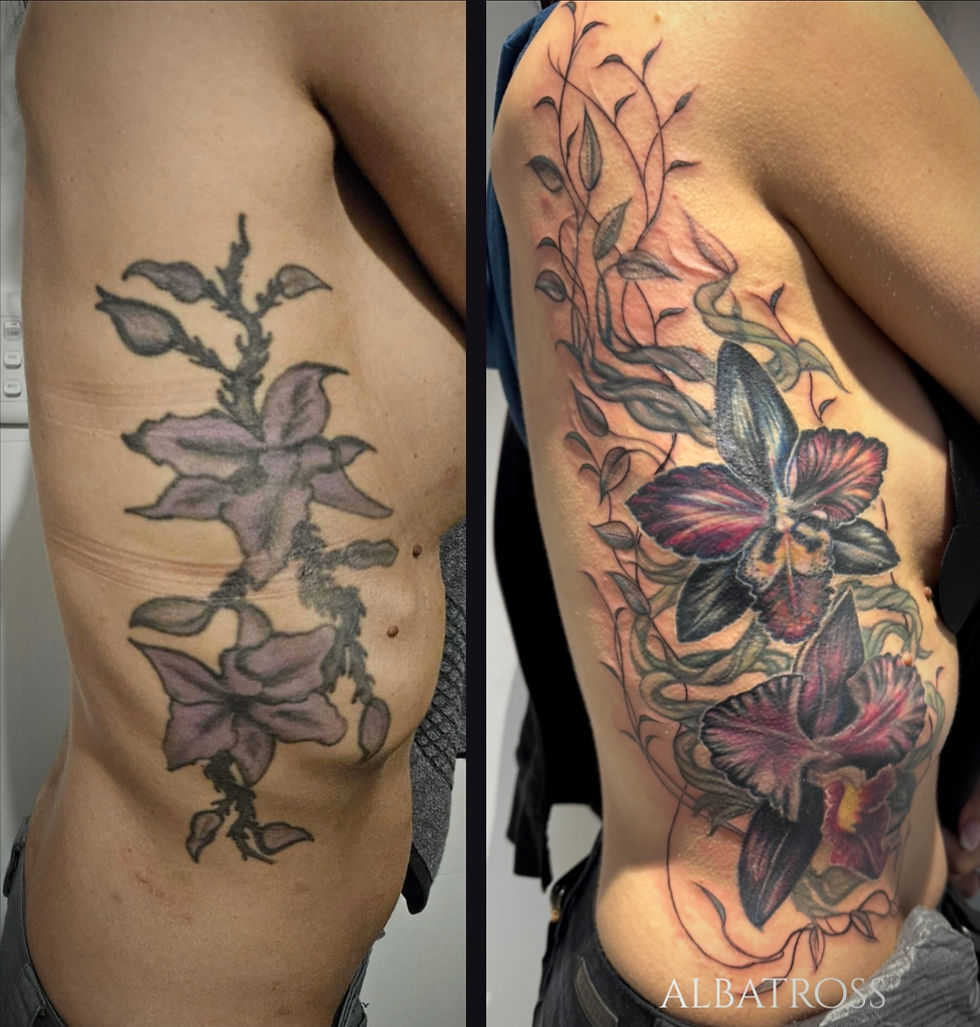
Integrate the scar into a larger piece so it's less obvious and gets lost in the artwork. Be prepared for double to tripple the scar size in your cover.

Break up the visual line of a scar with shapes, shading and texture.


What's not achievable

Restore lost texture or elasticity. Perfectly even colour as scar tissue often grabs and holds ink differently. The promise of 'invisibility', the scar will still exist under the tattoo. If anyone promises to 'completely hide' your scar with a tattoo, be cautious. The goal is usually camouflage and integration, not erasure.


How Scar Tissue Behaves Under the Needle. Understanding Coverup Tattoos


Scar tissue can:

  • Be tougher or more fibrous, making it harder to get ink in smoothly

  • Or the opposite – softer and more fragile, making it easier to overwork

  • Take pigment unevenly – some areas grab too much, some hardly at all


Understanding coverup tattoos provide some of the reasons why its imperative to come in for a consult. This isn't something that can be done over the phone, in person is always best.

It's not a given that your cover can be done and an in depth consult is where all the pros and cons can be explored and discussed.

What you may want to have done may not be feasible. Keeping an open mind to design options, size, texure, colour and approach is really the best frame of mind to have. Put yourself in the right hands and lean into the experience your chosen Artist offers.


THERE IS A WAY FORWARD! LETS WORK THROUGH THAT TOGETHER!


Covering a scar with a tattoo is entirely possible.


In the event you're considering such work, definitely start with a consult.

A consult is always necessary as Scar Covers and Camouflage are always case by case.

If you're not sure about where you sit at the moment with what you have the best thing is to make contact so we can talk it over. Working with trauma needs to feel right from the outset, go with your gut.

Ladies, I'm a Lady too with a private studio so it will just be us.


LETS TALK!


Comments

Rated 0 out of 5 stars.
No ratings yet

Commenting on this post isn't available anymore. Contact the site owner for more info.
bottom of page